
Claude Cowork
The Beginning of Something New

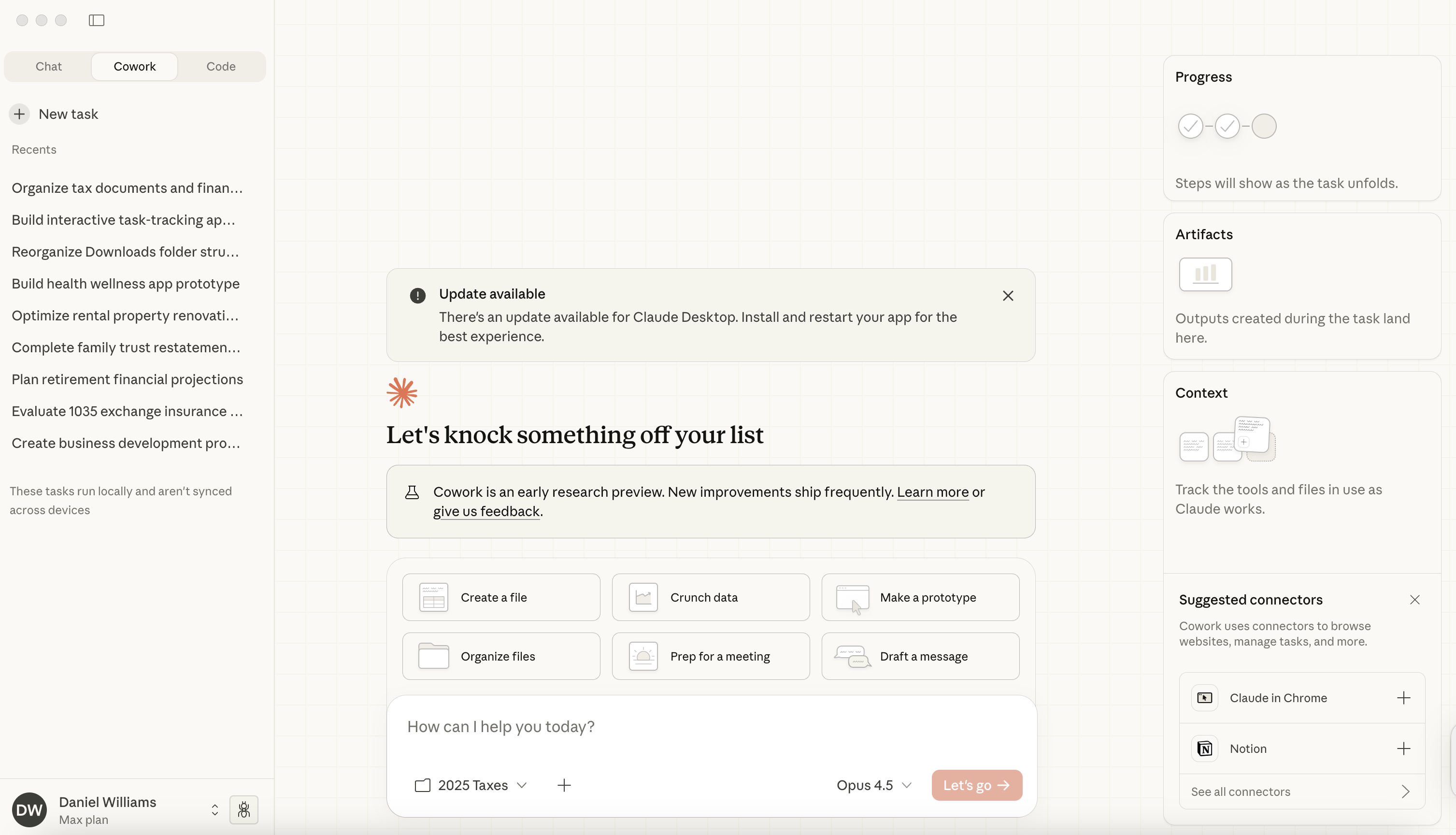
Last week, Anthropic released Cowork. Within 48 hours, my Twitter feed was flooded with demos of people organizing their Downloads folders, drafting legal documents, and building financial models, all without writing a single line of code.
But this isn’t just another AI feature announcement. After a week of using Cowork daily, I believe we’re witnessing something more fundamental: the first real crack in the browser’s 20-year grip on how we work with computers.
The Evolution We’ve Been Waiting For
Chat was the beginning. Then came coding agents, which Claude Code revolutionized. Now, Cowork, which I believe lays the foundation for what the future of work actually looks like.
Here’s the progression:
ChatGPT (2022): Ask questions, get answers. Revolutionary, but you still had to do the work.
Claude Code (2025): Tell it what to build, watch it code. Life-changing for developers. But locked behind a command-line interface that scared away everyone else.
Cowork (2026): Tell it what you need done, watch it happen on your desktop. No code. No terminal. Just results.
As TIME reported this week, Pietro Schirano, a former Anthropic engineer, uploaded his raw DNA data from AncestryDNA to Claude Code. The AI spawned multiple copies of itself, each simulating a different genomic expert. It told him he had a gene allowing him to metabolize caffeine better than average (explaining his seven-espresso habit), flagged predisposition to Alzheimer’s, and recommended supplements based on his genetic profile.
That’s not chatting. That’s working.
The Return to the Desktop
Here’s what most commentators are missing: Cowork is the first solution that opens a crack in the 20+ year grip that browsers have had on technology.
Think about it. For two decades, the trajectory has been clear: desktop → servers → cloud → browser. Your files moved to Google Drive. Your documents moved to Google Docs. Your email lives in a browser tab. Your entire digital life became something you access through Chrome.
Cowork reverses this. It brings AI back to your machine, working on your files, in your folders.
This isn’t just a productivity improvement. It’s a fundamental shift in who controls your data.
The timing couldn’t be more relevant. In June 2025, a federal court ordered OpenAI to preserve all ChatGPT conversations, including ones users had deleted, as part of the New York Times lawsuit. Users were outraged when they discovered their “deleted” chats weren’t actually gone.
Sam Altman’s response? He called for “AI privilege,” suggesting conversations with AI should be protected like talking to a lawyer or doctor. “We think this was an inappropriate request that sets a bad precedent,” he wrote on X. “We will fight any demand that compromises our users’ privacy.”
The problem is that with cloud-based AI, your data lives on someone else’s servers, subject to someone else’s legal obligations.
With Cowork, your files stay on your desktop. Claude mounts them into a sandboxed container, works on them, and returns results, but the source of truth remains your machine. In an era where platforms argue to retain data even after “deletion,” this architecture matters.
Salesforce’s Confession
This week also brought a confession that every CEO needs to hear.
Salesforce publicly admitted they were “too confident” in AI’s ability to replace human workers. After cutting 4,000 customer support roles in 2025, slashing their support workforce from 9,000 to 5,000, executives acknowledged that automated systems struggled with nuanced issues, complex escalations, and long-tail customer problems.
The result? Declining service quality. Higher complaint volumes. Internal firefighting to stabilize operations that experienced staff had once handled seamlessly.
Marc Benioff, who had previously celebrated AI as enabling the company to “hire fewer people while maintaining growth,” walked it back. Human expertise, it turns out, remains critical for customer trust, relationship management, and problem resolution.
Salesforce is the first of many companies who will admit this year that their belief they could replace workers with AI was a fool’s errand.
Here’s what CEOs need to understand: AI changes the nature of work, not the human connection to it. The human brain is still where creativity and problem-solving happen, long before being written as a document, email, Slack message, or increasingly, as prompts.
Anthropic itself made this point in a study released this week: AI is changing jobs more than eliminating them. AI is taking over parts of jobs, not entire roles.
Cowork embodies this philosophy. It’s not called “Claude Replace.” It’s called “Claude Cowork.” The framing matters.
What I’ve Actually Done With It
In one week, I’ve used Cowork for:
File organization: My Downloads folder had 1900+ files accumulated over 2 years. I pointed Cowork at it and said, “Organize these into logical folders, rename files clearly, and delete obvious duplicates.” 3 hours later: clean, categorized, done.
Legal document drafting: I needed trust documents for my attorney's review. Instead of starting from scratch or paying someone to draft from templates, I gave Cowork my drafts from my previous attorney, along with notes and comments. It produced second drafts that my attorney called “90% there.”
Financial modeling: I had insurance and retirement options to analyze. Spreadsheets, projections, scenario comparisons. The kind of work that would have taken me a weekend took less than 30 minutes of steering Cowork through iterations.
Tax filing prep: Cowork launched just in time to help me gather all my tax documents and organize them for my CPA. Usually, this process is annoying, but it has to be done every year. With Cowork, it was actually fun to see it analyze financial statements and bank records, and organize everything into a neat package for the CPA.
Life admin: That list of personal TODOs that had been sitting on the shelf for months? Gone. Doctor’s appointment research. Warranty claims. Travel planning. The kind of work that’s too small to hire someone for but too tedious to prioritize.
While Claude Code brought me back to loving software engineering, Cowork brought me back to loving the other half of my career, the part that I enjoyed being a technology consulting executive. It cleared the backlog that had been weighing on me.
The Race Is On
I expect every AI platform to follow suit and release a desktop app similar to Cowork very soon.
Simon Willison, the programmer and AI analyst, put it best: “I would be very surprised if Gemini and OpenAI don’t follow suit with their own offerings in this category.”
Google will do everything it can to maintain its browser-based empire with innovations like Gemini’s new “Personal Intelligence” feature, connecting your Google-based apps into a personalized AI experience. They’re integrating Gemini into Gmail for 3 billion users. The browser isn’t going down without a fight.
Microsoft has Copilot. Apple has whatever they’re working on. The incumbents will respond.
But here’s the thing: innovation rarely comes from large incumbents, especially when they’re coasting on cash cows. Microsoft and Apple have had the desktop position for decades. They could have built this. They didn’t.
Anthropic found something unique because they weren’t protecting existing revenue streams. They built what users actually needed.
The Meta-Point
Here’s the detail that should make you think: Cowork was built in approximately 10 days. All the code was written by Claude itself.
Let that sink in. An AI coding tool built an AI productivity tool. In less than two weeks. With zero human code.
As one Anthropic engineer described it: “We built Cowork the same way we want people to use Claude: describing what we needed, letting Claude handle implementation, and steering as we went.”
This is the recursive improvement loop actually happening. And it just landed on your desktop.
What This Means for You
We are witnessing not an end of “chat” but a beginning of something new.
Knowledge work has always existed in files and folders on the desktop. Then it moved to servers. Then to the cloud. In many ways, Cowork should have been developed by companies like Microsoft or Apple.
Instead, it came from a safety-focused AI company that started by warning about existential risk and ended up shipping the most practical productivity tool of the decade.
The implications:
Your desktop matters again. The files on your computer are no longer just local backups of cloud documents. They’re the workspace where AI collaborates with you.
AI augmentation beats AI replacement. Salesforce learned this the hard way. The companies that thrive will be the ones that use AI to amplify human capability, not eliminate it.
Data sovereignty matters. Where your data lives determines who can access it. Cowork’s architecture, local files, and sandboxed execution are features, not limitations.
The interface is the product. Claude Code and Cowork use the same underlying technology. The difference is accessibility. A command line scares people. A folder doesn’t.
I’ve been writing this newsletter about Claude Code for non-coders for months now. With Cowork, the name finally makes literal sense.
The future of work isn’t about replacing workers with AI. It’s about giving every worker an AI teammate that can actually execute, not just advise.
That future arrived this week. It’s called Cowork.
What have you tried with Cowork? Reply and let me know, I’m collecting use cases for a future issue
I just recently got access when they opened up to Pro users so I'm going to be giving it a go and see where it fits in my day. I've been going deep in Claude Code so because of that, I may not be the right persona for Cowork.