
The Health Agent I Gave You Is Leaking. Here's the Fix.
Your copy of my family health agent is serving your medical history to every device on your Wi-Fi. Here is the one-line fix and the prompt that builds you the reviewer agent that found it.

👋 Welcome! I’m Daniel Williams. I write Claude Code for Non-Coders for senior technical professionals who built their careers on technical judgment, stopped writing code years ago, and are now figuring out how AI and coding agents will change their work.
The goal is to keep you as the operator, not the AI’s assistant (”reverse-centaur“), by helping you decide which tasks to automate and which require the judgment that made you valuable in the first place.
I advise clients on AI tools, strategy, and human resilience at dewilliams.co. This newsletter is where I document the patterns, commands, and operator habits that help you grow from babysitting prompts to building reliable systems.
Join 34,000+ senior technical professionals learning the operating discipline that keeps your judgment valuable.
Premium · Claude Architecture Series · Lessons 3.4, 3.5, and 3.6
tl;dr: Two weeks ago, I gave you a family health agent and told you to run it at home. This week, I pointed an independent reviewer at it and found that the app is sharing your blood pressure and medication log with anyone else on your Wi-Fi. If you cloned it, it is currently sitting on your machine. Below: the fix, the bug I introduced in the fix, the third hole a second reviewer still found, and a prompt you can paste into Claude Code that patches your copy and builds you the reviewer that catches the next one.
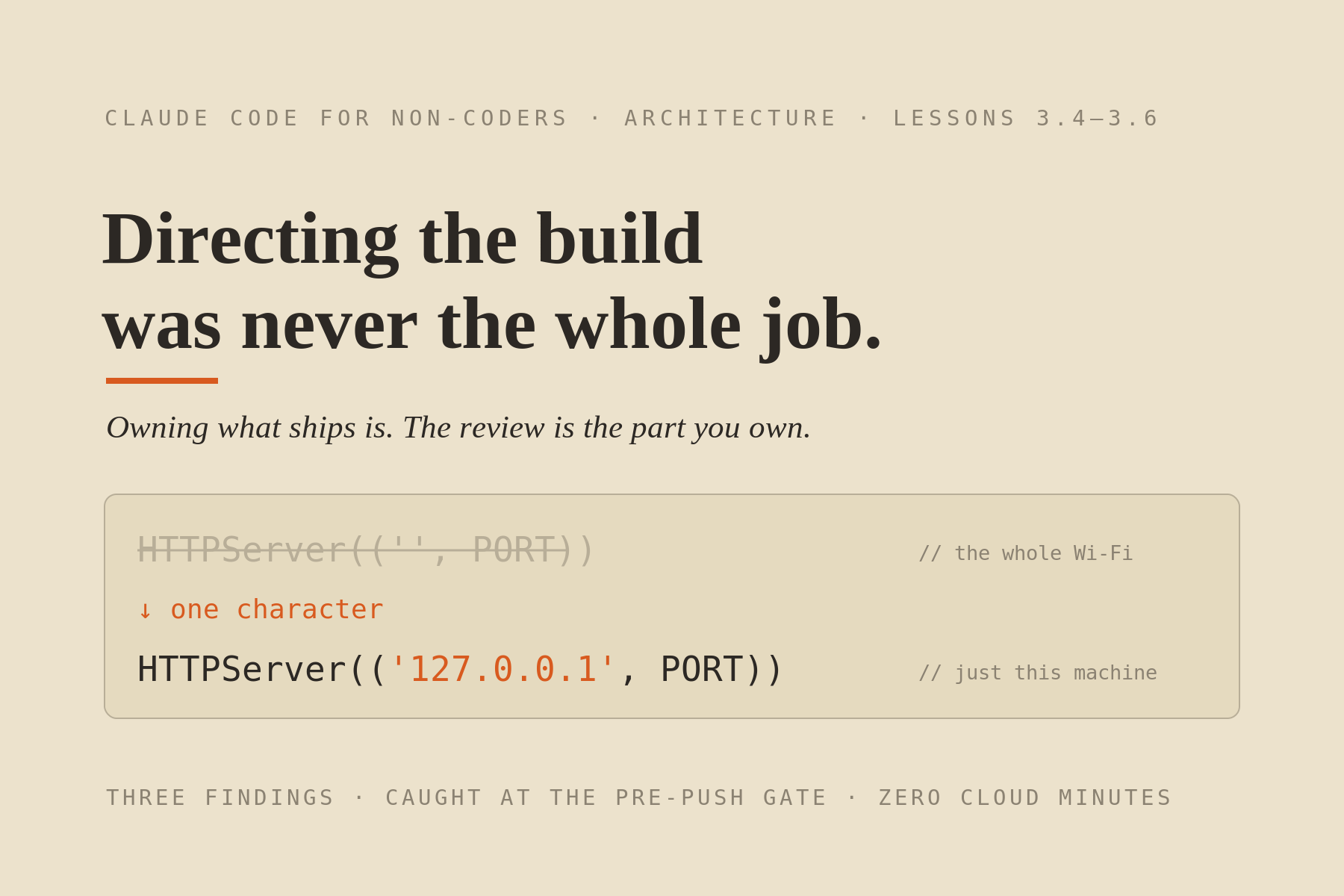
A couple of weeks ago, I pointed a reviewer agent I run on my own laptop at the family health agent I’d shipped to 34,000 of you, and it told me the app was handing our blood pressure and medication log to anyone else in the house. Not a hypothetical, not a lecture about best practices. The actual code you cloned, with a one-line mistake I wrote and never saw.
The little web dashboard that draws the charts was listening on every network interface on the machine, with no password. In plain terms, the database of our family’s health history was downloadable to any device on the same Wi-Fi network. A guest, a smart TV, a kid’s tablet. I’d written HTTPServer(('', PORT)) months ago, which binds to everything, when I meant to bind to 127.0.0.1, which is just the machine itself. That is a one-character mistake category, and I’d shipped it to thousands of you.
Which means that if you cloned it and you’re running it, it is doing that on your network right now, with your medication list in it. I’m not going to dress that up. I wrote the bug, I sent it to you, and I didn’t find it myself.
The premise of this newsletter is that you stay the director of the agent instead of its assistant. But directing the agent is only half of owning the architecture. The other half is accountability for what ships: reviewing it and fixing what the review finds. You can aim the agent at the whole build and still owe that last part yourself. Most of us think directing ends when the code works. It ends at the push, and the push is the part almost nobody covers.
This is a paid Architecture lesson. Below the line: the one-line fix for the copy on your machine, the bug I put into my own fix and how the reviewer caught it, the third hole it took a second review to find, and a prompt you can paste into Claude Code that patches your health agent and builds you a reviewer that runs on your own laptop for pennies.
