
Weekend Dispatch: Architect or Be Architected
Everyone’s reading this week’s four AI stories wrong: the FDE rebrand, Karpathy’s compression test, the brake Citrini missed, and Nvidia on your wall.

This is the first CC4NC Weekend Dispatch, a free, feed-only roundup of the week’s most important AI developments through the strategic builder’s lens. Short, reactive, and designed to keep you current without adding to your inbox.
OpenAI, Anthropic, and Google just spent $5.5 billion hiring consultants and calling them something else.
They’re calling them “Forward Deployed Engineers” (FDE). The price tag is $10K/day. The job is to sit inside your company and make AI work for you. As one commenter put it: “I have about 20 years of experience as a forward-deployed engineer, we used to call them consultants.”
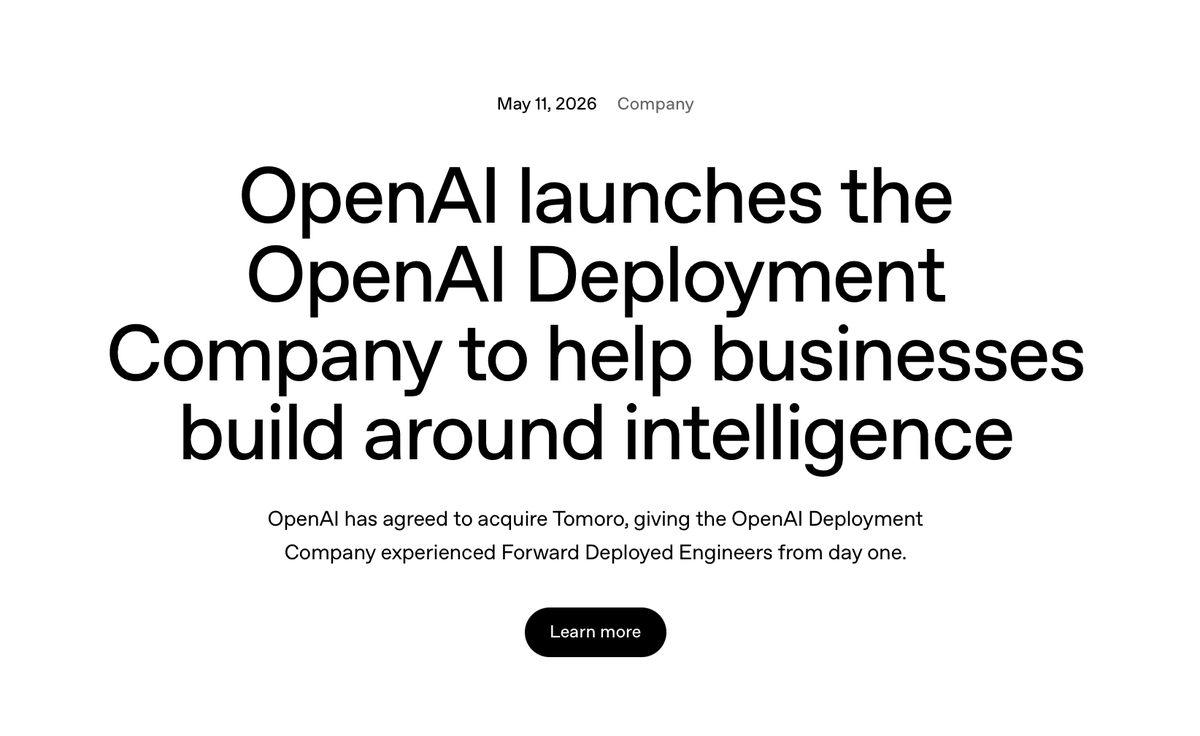
OpenAI launched a $4 billion deployment company and acquired Tomoro to staff it with 150 FDEs. Anthropic raised $1.5 billion with Blackstone and Goldman Sachs for the same play. Google is recruiting hundreds more. EPAM is certifying 10,000 Claude architects. Aaron Levie calls it one of the most in-demand jobs in tech.
Allie Miller got closest to what everyone else is dancing around: external FDEs won’t make your company AI-first. You can customize the deployment and still have your employees avoid AI and distrust every leadership decision around it. Her Salesforce analogy: you can customize the implementation, but that won’t make your sales team fix their data hygiene.
Platforms are going headless because customers have already picked their agents elsewhere. Salesforce tried Agentforce. Notion tried Notion AI. People used Claude or ChatGPT instead, because nobody wants to learn a different agent for every SaaS tool they touch. Salesforce launched Headless 360 in April: 60+ MCP tools that let your agent of choice operate the platform without a UI. Notion shipped its developer platform on Tuesday with Workers, Database Sync, and external agent support. The platforms aren’t competing to be the agent anymore. They’re competing to be the substrate the agent runs on.
Your client already has Claude Desktop. They already have Codex. I frequently recommend Claude Desktop to clients, friends, and family members. My cousin started using Claude Cowork and found tens of thousands in change order value from an electrical spec on day one. No FDE. No SOW. What we discussed afterward was the architecture he couldn’t build himself. If your value disappears when the client opens a $20/month tool, you’re not selling expertise. You’re selling navigation through complexity you could have simplified.
This bifurcates the FDE play. Simple integrations and happy-path workflows go to the frontier lab-released skills, SaaS MCP connectors, and the desktop agent that the buyer already pays for. The hard cases are messy data, cross-system architecture, and domain logic that nobody wrote down. Those need humans with context: call them FDEs, call them consultants, call them internal builders with the skill and authority to make it work. Every company with legacy systems and compliance burdens genuinely needs that help. The $5.5 billion bet is reasonable for the hard half. The risk is that most buyers can’t yet tell which half they’re in.
Remove all the code from your app. Give the raw input directly to an LLM. Is the output roughly the same?
That’s Karpathy’s test. He ran it on his own product, and it failed.
He built Menu Gen: a photo of a restaurant menu goes through OCR, an image model generates pictures of each dish, and the app re-renders the menu with food photos next to every item. Full pipeline. Deployed on Vercel. Someone gave Gemini the same photo with one prompt: “overlay pictures of each dish onto the menu.” Gemini returned the original menu with food images rendered directly into the pixels. One prompt. The entire app is unnecessary.
I ran this test on two of my own products. One passed cleanly; the knowledge maturation pipeline does things no single prompt can replicate. The other was closer to the line than I expected.
The 20% that survives has to be something the model genuinely cannot do: persisting state across users, enforcing access controls, processing payments, connecting to hardware. If your 20% is “better formatting” or “a nicer UI,” you’re in the 80% that’s about to get compressed. Run the test before the market runs it for you.
Video: Karpathy discussing his app getting oneshotted
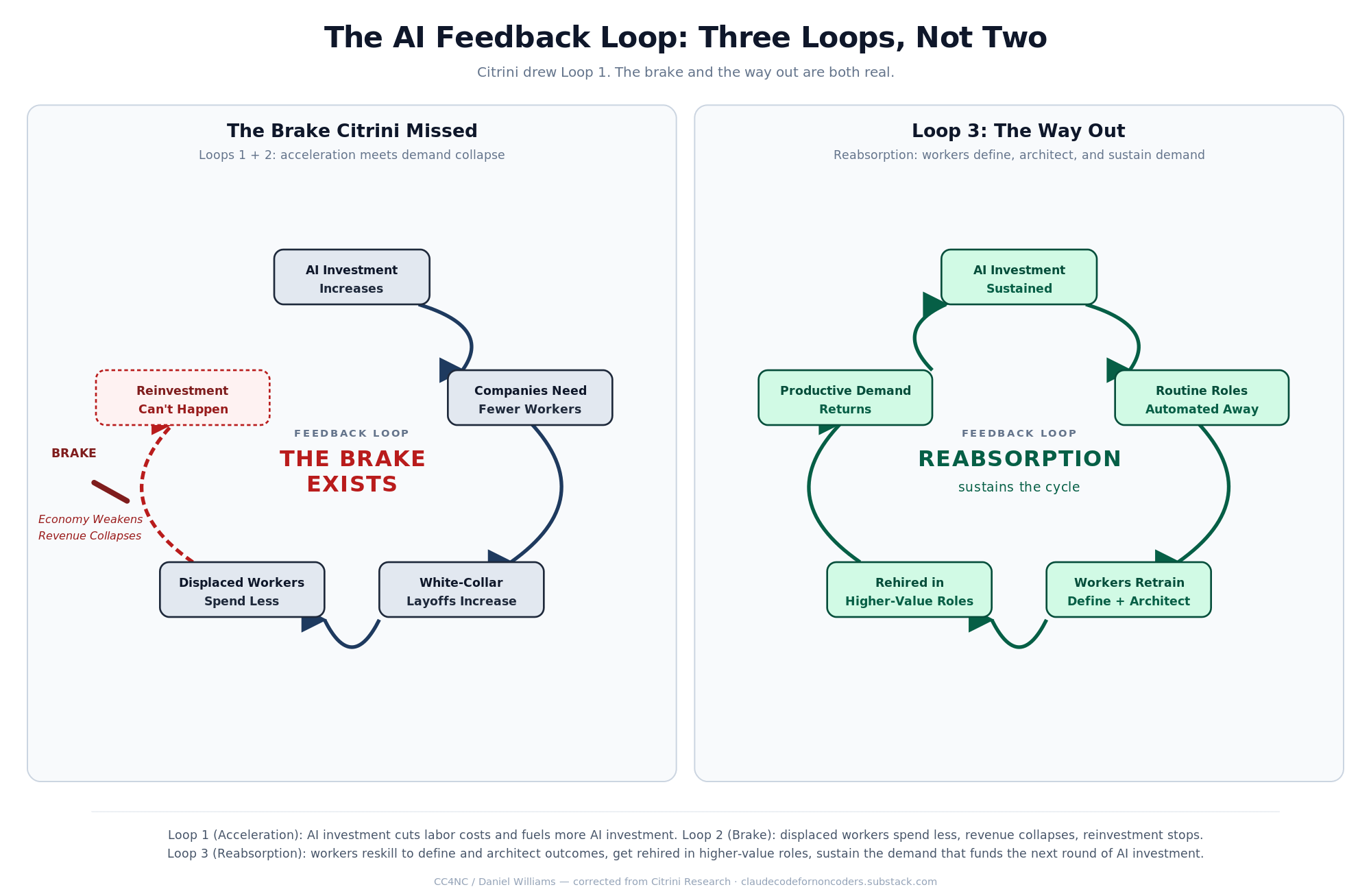
Citrini’s “No Natural Brake” diagram includes a brake. They drew it and forgot to label it.
Citrini Research published “The 2028 Global Intelligence Crisis,” a fictional memo from June 2028. The diagram went everywhere: AI improves, companies need fewer workers, layoffs increase, displaced workers spend less, the economy weakens, and companies invest more in AI. Stamped across the top: “No Natural Brake.”
Displaced workers spend less. The economy weakens. That is the brake. Agents don’t buy coffee or pay rent. The income has to flow to someone who does. When it stops flowing, consumption collapses. When consumption collapses, revenue disappears. When revenue disappears, nobody is funding the next round of AI investment. The brake isn’t gentle: it’s a recession. But it exists.
The strongest objection is that automation could close the loop without consumers at all. Wealthy investors fund automated B2B chains supplying other automated businesses. Capital cycles through machines that never needed human spending in the first place. The Thiel/Yarvin enclave scenario. It’s the most coherent version of “no brake,” and short of an authoritarian solution to the political problem, it can’t run at a steady state. Capital is only valuable to the extent it commands real goods, services, or political power. Pure capital-serving-capital resolves into paper wealth nobody can redeem. The closed loop is a transient: it lasts as long as investors keep funding the bet, and breaks when they notice revenue isn’t materializing or when joblessness becomes politically untenable. Reabsorption isn’t just morally preferable. It’s the only durable equilibrium short of authoritarian enclosure.
The real question is speed. Does the acceleration hit the demand brake before or after the labor market adjusts? History suggests markets do adjust: new roles absorb displaced workers, but only if there’s a reabsorption mechanism. That mechanism is the third loop Citrini left off the diagram: displaced workers who learn to define and architect outcomes rather than execute tasks. Forrester found 55% of employers regret AI-related layoffs. The companies that cut too fast didn’t lose friction. They lost the judgment that knew when the AI output was wrong.
If you’re reading this newsletter, you’re building the skills that put you in the third loop. The question is whether enough of the labor market gets there before the brake kicks in.
Nvidia is running the mineral rights playbook with silicon instead of coal. You should want to own the compute, not rent out your wall.
Nvidia and PulteGroup are installing XFRA nodes on residential properties. Liquid-cooled, fanless GPUs mounted on exterior walls. Deploys 6x faster and 5x cheaper than building a data center. The homeowner provides the wall, the electricity, and the network connection. Nvidia keeps the compute revenue. The homeowner gets a discount on their electric bill.
In Appalachia, homeowners owned the surface while coal companies owned the mineral rights. The wealth left the community. This is the same structure with a different commodity.
The alternative exists. A Raspberry Pi 5 running open models handles routine inference for $150. Frontier APIs handle the complex reasoning on demand. One of my readers runs three AI systems, coordinated through LocalMemory on a Pi 5—Claude and two open-source models, that share a unified knowledge layer. Not theoretical. Running in production.
Most homeowners can’t set up a home server today. But most homeowners couldn’t set up a home network in 2003 either. The infrastructure will get easier. The question is whether you’re positioned as the owner or the tenant when it does. The internet followed this arc: mainframes, client-server, cloud, edge. AI is following. NVIDIA is building step 3. The people who set up step 4 own their data, costs, and independence from providers that can change pricing overnight.

Claude Code for Non-Coders publishes Tuesdays and Thursdays. Weekend Dispatch covers the week’s biggest AI developments through a builder’s lens.
Daniel Williams advises clients about AI tools, strategy, and human resilience at dewilliams.co.