
Weekend Dispatch: The Models Went Quiet, The Money Got Loud
Opus 4.8 was a polish. SpaceX, OpenAI, and Anthropic all filed to go public inside three weeks. Early investors are cashing out of the frontier.

The models went quiet
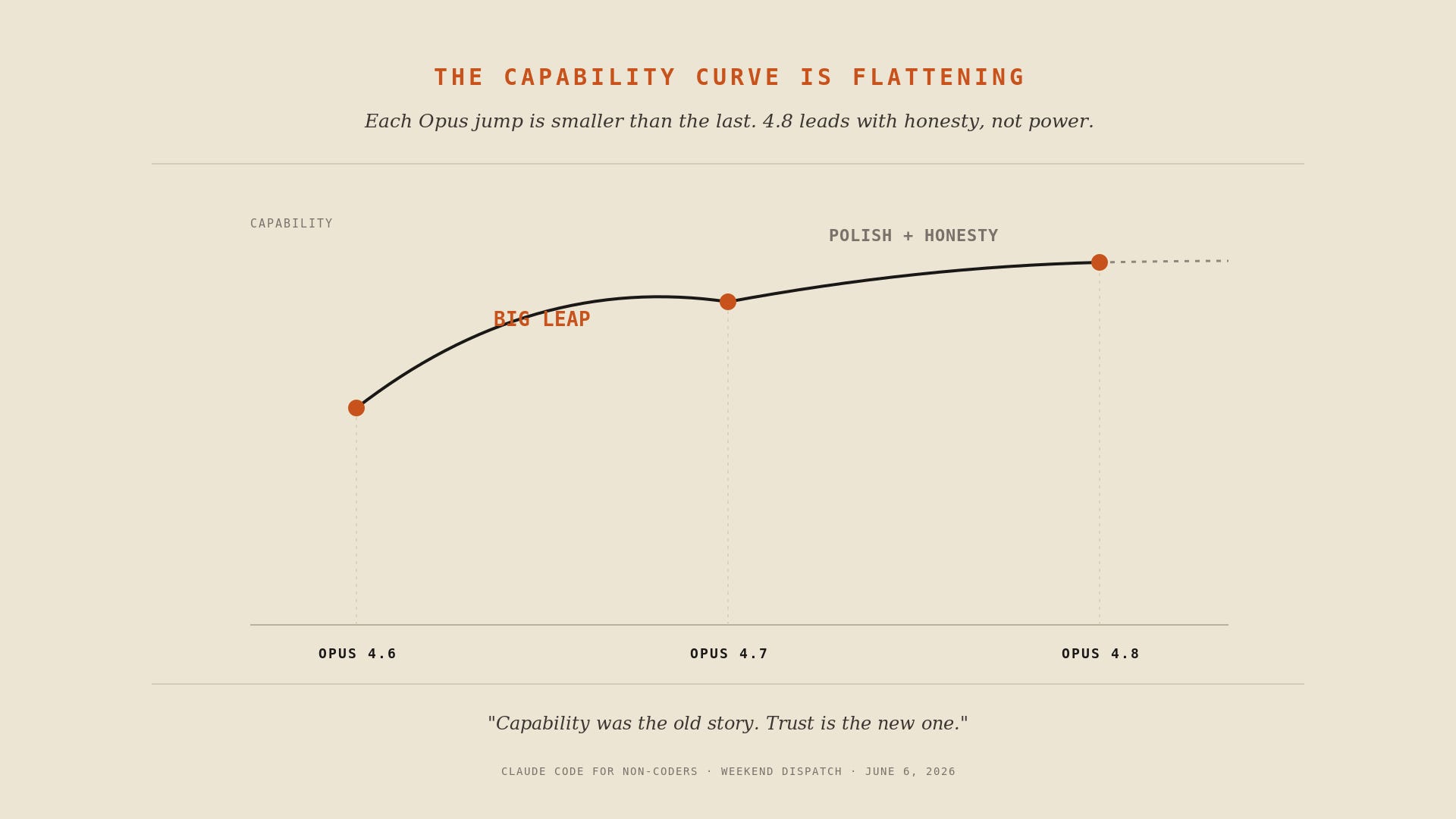
Anthropic shipped Claude Opus 4.8 on May 28, and the notable part is how little changed. It costs the same as 4.7 ($5 per million input tokens and $25 for output), and Anthropic calls it “a modest but tangible improvement.” The headline feature isn’t power. It’s honesty: 4.8 is about four times less likely than 4.7 to let a flaw in its own code pass unremarked, and it flags its own uncertainty instead of bluffing through it (Anthropic). The company’s own roadmap note says the next priority is cheaper models at Opus-level capability. The leaps are becoming refinements.
For two years, the operating assumption was that the next model would be the one that changed your work. That assumption is quietly expiring. When a flagship release leads with candor about its own mistakes rather than a new capability, the frontier has stopped sprinting. I called 4.7 an advisor rather than an executor back in April (the regression isn’t in the model); 4.8 is the same advisor, now willing to tell you where its work is thin.
That changes the question you bring to a new model. Not “how much smarter is it,” but “is it honest enough to trust in something that matters.” Model capability has always been the story. Model trustworthiness is what we’re tracking now.
The money got loud
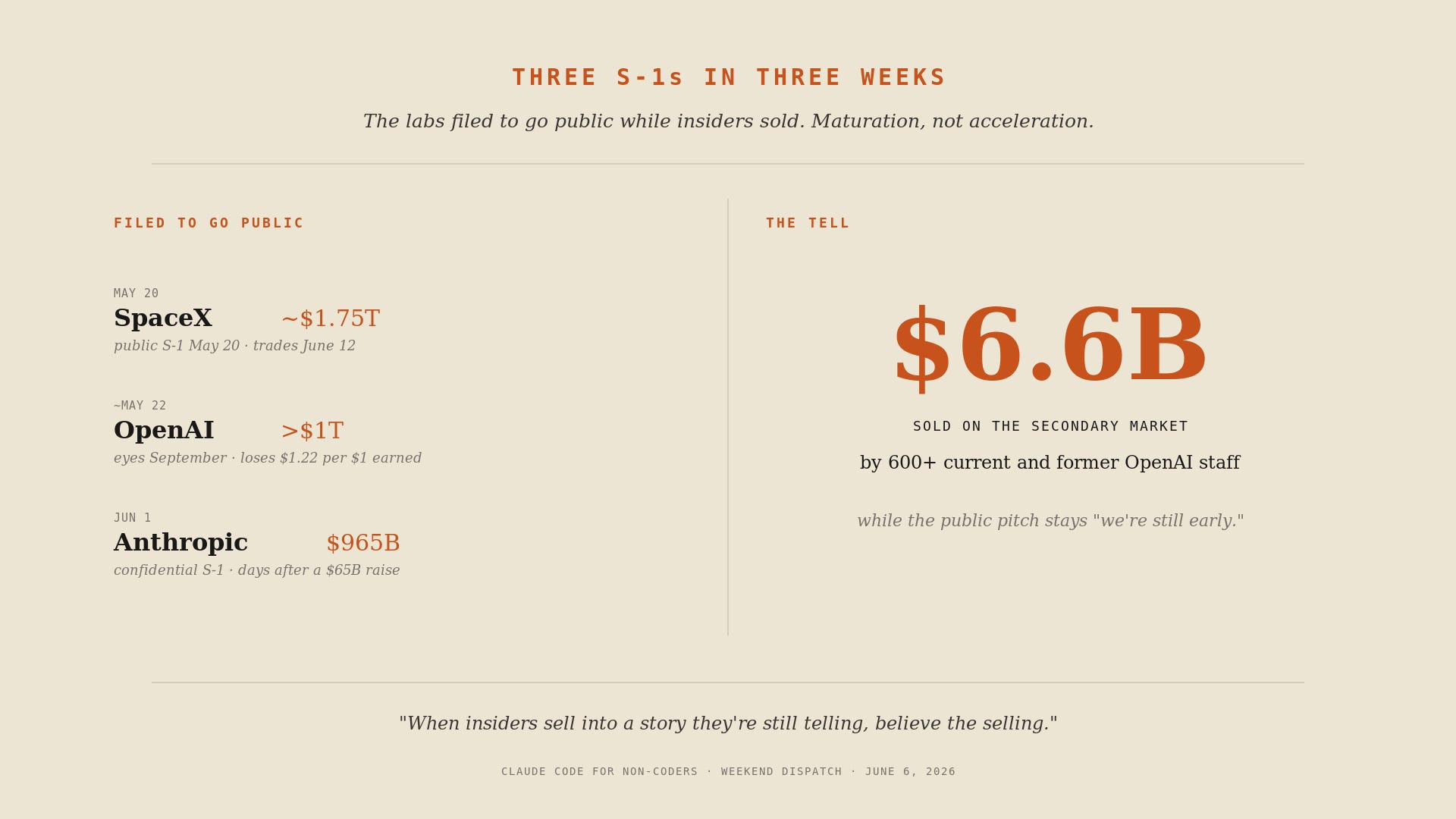
While the models inched, the money sprinted. SpaceX filed its public S-1 on May 20 and starts trading June 12 at roughly $1.75 trillion (CNBC). OpenAI filed confidentially around May 22, targeting a September listing above a trillion dollars while still losing about $1.22 for every dollar it earns on $2 billion a month in revenue (CNBC). Anthropic filed its own confidential S-1 on June 1, days after raising $65 billion at a $965 billion valuation (NPR). Three of the largest IPOs in history were queued inside three weeks.
The roadshow will sell this as acceleration. Read it the other way. Companies file to go public when the land-grab is maturing into a business that needs public capital and owes shareholders predictable returns, not when the next breakthrough is around the corner. The clearest tell came before the filings: more than 600 current and former OpenAI staff had already sold $6.6 billion in shares on the secondary market (TradingKey). The people with the best information are trimming exposure while the public message stays “we’re still early.”
I’m not telling you what to do with a brokerage account; this isn’t that newsletter. It’s a signal about the industry, not your portfolio. When the people building these companies are cashing out, be skeptical of the “we’re still early” story they’re telling everyone else.
Build so you can leave
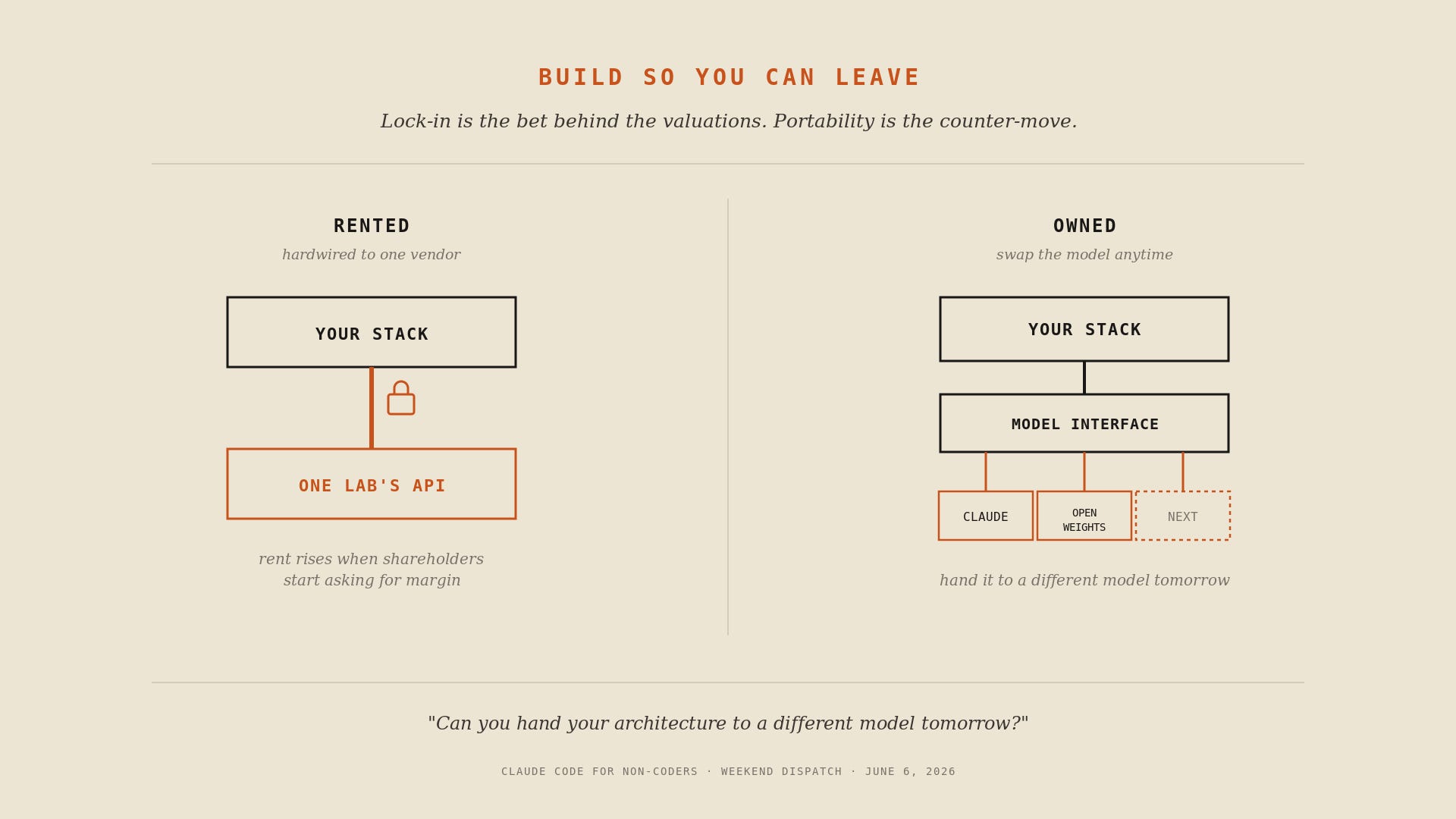
If the models are commoditizing and the labs are filing to go public, the operator’s move is to make sure you can walk out the door. A trillion-dollar valuation prices in durable pricing power, and pricing power requires switching costs. The thing that erodes switching costs is open-weight models getting good enough to run yourself. DeepSeek V4 and Qwen 3.6 already turned frontier-adjacent intelligence into something you can host, and the gap to the closed models keeps narrowing. Every closed-model IPO is, underneath, a wager that open weights stay second-rate.
Sovereignty here isn’t about running open-source locally because it feels principled. It’s narrower: can you hand your architecture to a different model tomorrow without rebuilding it from scratch? If yes, the labs’ pricing power doesn’t reach you. If no, you’re renting your leverage from whichever vendor you hardwired, and the rent goes up the moment public shareholders start asking for margin. Build model-agnostic now, while it’s a design choice and not a fire drill.
I’m taking this all the way on Thursday: why China didn’t wait for permission to build its own AI stack, and what model sovereignty means for the systems you’re standing up this year.
Claude Code for Non-Coders publishes Tuesdays and Thursdays. Weekend Dispatch covers the week’s biggest AI developments through a builder’s lens.
Daniel Williams advises clients about AI tools, strategy, and human resilience at dewilliams.co.
Hey Daniel,
I agree with that. I think there are several options, not just local models, but models on a VPS or even TypingMind. A solution like that can actually host (or run) multiple models and compare their responses.
In the near future, I would be interested to see if we can co-create some articles together. I have nowhere near the authority that you have on your own Substack, but I'm keen to expand and leverage this platform in the Italian market and in the English market as well.
Daniel, this is a great post. I think you should do something even more practical: a guide for actually setting up a local model on your own tech stack or on a VPS (like Hostinger) and then connecting it to infrastructure.
For example, you could show how to connect it to an Hermes agent or an n8n self-hosted architecture.